
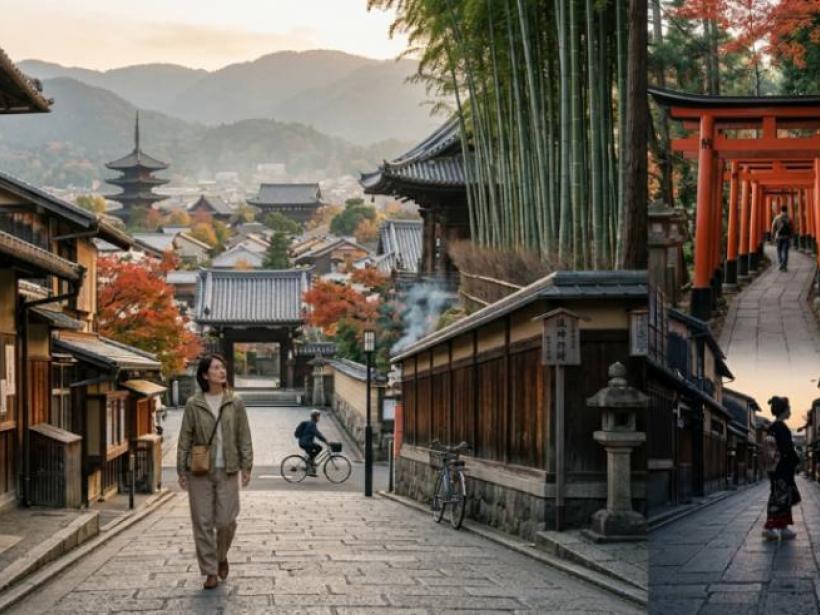

Kyoto is Japan's former imperial capital – 1,600 Buddhist temples, 400 Shinto shrines, and 17 UNESCO World Heritage Sites inside an area you could cycle across in under an hour. Four days is the right amount of time. Budget $80 to $120 USD per day for mid-range travel, covering accommodation, food, and transport. Skip the tour buses. The city bus network costs 700 yen for a one-day pass and reaches almost every major site. Before you book, it's worth reading up on how to stretch your travel budget without sacrificing the highlights.
Day 1: Eastern Kyoto (Higashiyama District)
Walk the stone-paved Ninenzaka and Sannenzaka lanes before 9 a.m. Kiyomizudera Temple sits at the top of the hill, with a wide wooden stage jutting over the valley below. Entry costs 500 yen. The view from that platform is one of the few genuinely memorable moments you'll take home.
Spend the afternoon in Gion, Kyoto's geisha district. Walk Hanamikoji Street around 5 to 6 p.m., when geiko and maiko occasionally appear between appointments. Photographing from a distance is fine. Following them is not.
Day 2: Arashiyama and the Bamboo Grove
About 25 minutes by train from central Kyoto, Arashiyama rewards early arrivals. The bamboo grove at Sagano fills quickly after 9 a.m. and the experience shifts completely once that happens – get there before 8. Tenryuji Temple borders the grove with one of Japan's finest garden designs (500 yen entry). Afterwards, walk north to the quieter temples of Jojakoji and Nonomiya Shrine. Both take about 45 minutes combined and see a fraction of the bamboo grove traffic.
Day 3: Nijo Castle and Fushimi Inari
Start at Nishiki Market, a five-block covered arcade where around 130 vendors sell pickled vegetables, grilled skewers, fresh tofu, and matcha sweets. Go hungry. Nearby, Nijo Castle gives a clear picture of feudal Japan – the floors were designed to creak underfoot as a security measure. Entry costs 1,030 yen.
In the afternoon, Fushimi Inari Taisha sits 20 minutes south by train. The corridor of red torii gates runs 4 km up the mountain. Walking past the first two rest stops puts you in noticeably thinner company.
Day 4: Northern Temples and a Final Meal
Finish with Kinkakuji (the Golden Pavilion, 500 yen) and Ryoanji Temple's famous rock garden – 15 stones arranged so no single viewpoint reveals all 15. Leave the afternoon for Teramachi Street or a kaiseki lunch, which runs 3,000 to 5,000 yen at mid-range restaurants.
When to Go
Late March and early November offer peak colour without the worst of the crowds. Summer is humid. Winter is quiet and cheap. A business hotel runs $70 to $120 USD per night. A ryokan with meals costs $200 to $400 USD. Book at least eight weeks ahead near blossom or leaf season. First-time visitors to the region will find the preparation principles transfer well beyond Australia.