
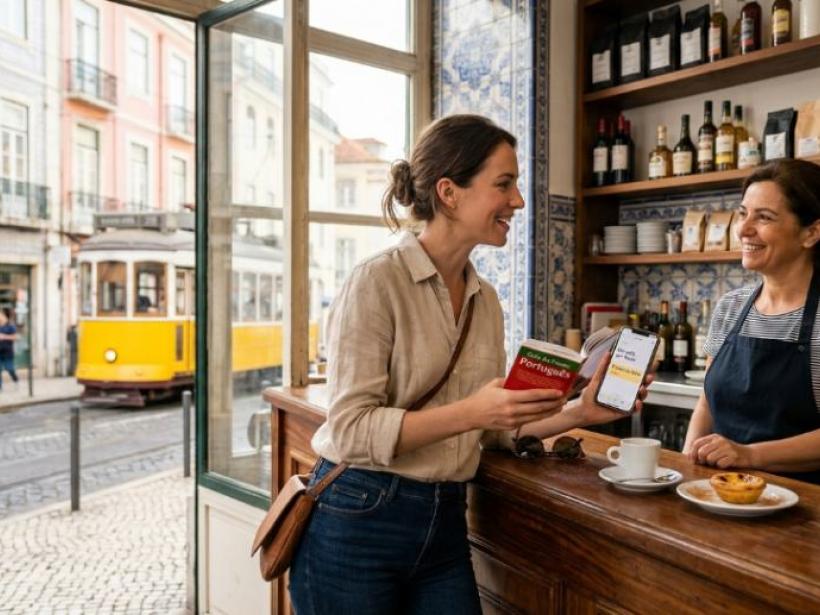

Most phrase lists hand you "olá" and "obrigado" and call it done. That's not where travelers get stuck. The real friction shows up in three places: pronunciation that makes locals switch to English on you mid-sentence, a gendered ending on "obrigado" nobody bothers explaining, and the gap between what works in Lisbon and what works in Rio.
Quick answer: learn the sounds before you learn more words. Portuguese has a nasal sound with no English equivalent, and getting it wrong is often why people clock you as a tourist before you finish your sentence.
Why "obrigado" trips people up
It's not gender neutral. Phrasebooks usually bury that fact in a footnote nobody reads. Men say obrigado. Women say obrigada. Get it backwards and nobody corrects you, but it registers as a small slip for the rest of the trip.
Here's the part that actually confuses people: the ending depends on your own gender, not the gender of whoever you're thanking. Say it to a room full of men while you're a woman, you still say obrigada. That single rule trips up more travelers than any missing vocabulary word ever does.
The sound that gives you away
Forget the words for a second. It's "ão," the ending in não, pão, então, that gives people away. English speakers flatten it into something like "now" or "own." Native speakers hear a nasal sound closer to saying "now" while humming through your nose at the same time, and there's really no clean English match for it.
Try this instead of another flashcard session. Record yourself saying "não" on your phone. Pull up a native pronunciation clip. Compare them. Fifteen minutes of that teaches you more than an hour of vocabulary drills.
Portugal and Brazil aren't quite the same language
Generic lists treat European and Brazilian Portuguese like they're interchangeable. They're close, but three gaps matter if you're actually traveling. Portugal says "autocarro" for bus, Brazil says "ônibus." Portugal leans on "tu" for casual address, Brazil defaults to "você" almost everywhere. And "fixe," the Portuguese word for cool or great, earns a confused look in São Paulo.
Use Brazilian vocabulary in Lisbon and people will still understand you fine. They'll also notice you learned from a Brazilian teacher, and sometimes that turns a quick bus ticket purchase into a five minute conversation about where you picked it up. If Lisbon's hills and views are already on your itinerary, it's worth locking in the European vocabulary before you land.
A better opener than "fala inglês?"
Everyone learns "Fala inglês?" It works. It also signals that you're not planning to try. A stronger line: "Desculpe, o meu português não é muito bom, mas..." (sorry, my Portuguese isn't great, but...) followed by your actual question, in Portuguese.
I've watched this shift the entire tone of an interaction in small towns outside Lisbon. The words aren't fancier. You just signaled effort before asking for help, and people respond to that.
Four days of ordering coffee wrong
A traveler in Lisbon asked for "um café" and got a tiny, intensely strong espresso every time. That's the default meaning of café in Portugal. She wanted something closer to a regular coffee, and the word she'd learned in Brazil simply didn't map the same way here. The fix: "uma meia de leite" for something closer to a latte, or "um garoto" for a small coffee with a splash of milk. Neither one shows up on the usual tourist lists.
Phrases worth actually memorizing
Each one here solves a real problem, not just a polite gesture:
- Por favor, mais devagar (please, slower). Works better than asking someone to repeat themselves, since repeating fast speech just gives you more fast speech.
- Pode ajudar-me? (can you help me?). Reads as more natural than a flat request.
- Estou só a ver (I'm just looking). Portugal specific, and it stops shop staff from hovering.
- Aceita cartão? (do you take card?). Still worth asking in 2026. Cash only spots exist outside the bigger cities, so it helps to plan around that the same way you'd stretch a travel budget anywhere else.
FAQ
Do Portuguese people mind if I mispronounce words?
Not usually. The "ão" sound is the exception. It's the one thing locals will actually stop and correct, mostly because it's genuinely hard for foreigners to fake.
Is it rude to use "tu" with strangers?
In Portugal, a little. It comes across as overly familiar with someone you haven't met. Skip the pronoun, or use "você," until someone signals it's fine to loosen up.
Why does "café" get me an espresso every time?
Because in Portugal, café means espresso by default. Ask for meia de leite or garoto if you want it milkier.
Skip memorizing forty words off a list. Nail the "ão" sound, remember your own gender ending on obrigado, and stick to one region's vocabulary instead of mixing Brazilian and European Portuguese. That's what actually gets you through a trip without the small, constant friction of being read as careless.