
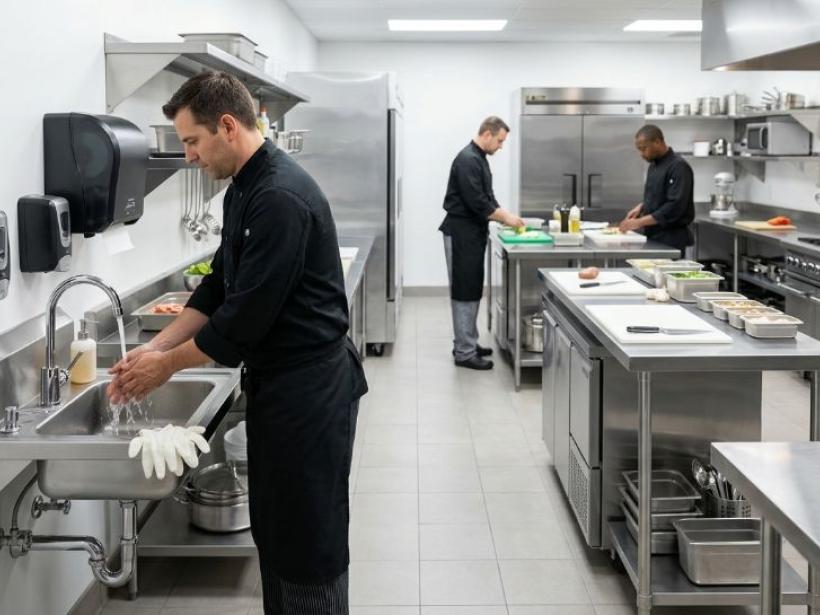

Health inspectors check for a hand sink in every food-prep zone before they check almost anything else, and a wall mounted hand sink installed in the wrong spot is one of the fastest ways to pick up a citation on an otherwise clean visit. Placement rules are specific enough that “close to the prep line” is not good enough on its own, and the requirement gets stricter, not looser, once a kitchen adds a second prep station or a dish pit on the far side of the room.
How Far Is Too Far? Proximity Requirements
Most local health codes require a hand sink within 25 feet of travel distance from any food-prep or dishwashing station, measured along the actual walking path a cook would take, not a straight line through a wall or counter. Blocking that path with a rolling cart or trash can during a busy shift is one of the more common findings on an otherwise clean inspection report. A wall mounted hand sink solves part of this problem simply by taking up no floor space, which keeps the required clearance intact even in a kitchen already tight on room. In a renovation, this often means the sink location gets fixed early in the plumbing rough-in stage, well before final equipment layout is confirmed. Changing that location after rough-in is far more disruptive than adjusting a table or shelving position, since it involves breaking into a finished floor or wall to relocate supply and drain lines.
Configuration Details Inspectors Look For
Beyond distance, inspectors look closely at what surrounds the sink itself. Hot water at a hand sink must reach at least 100°F, and soap and towel dispensers need to sit within easy reach of someone standing at the bowl, not mounted on an adjacent wall out of arm's reach. Mounting height matters too, particularly in spaces open to the public: the U.S. Access Board's technical guide on lavatories and sinks sets out rim height and clearance specifications that keep a fixture usable by staff and guests with a range of physical abilities. Choosing a properly configured wall mounted hand sink with an integrated soap and towel bracket removes one more variable from an already long pre-opening checklist.
Getting placement and configuration right before the first inspection saves a second site visit and the delay to opening day that comes with it. A short walkthrough with the actual food-prep and dishwashing flow mapped out, sink locations included, tends to catch a spacing problem long before a health inspector does.
FAQ
Q: Can a hand sink also be used for food prep?
A: No. Hand sinks are dedicated fixtures, and using one for food prep or dish rinsing is a common violation that inspectors treat separately from cross-contamination found at a prep sink.
Q: Does every kitchen need more than one hand sink?
A: Kitchens with prep and dishwashing zones more than 25 feet apart typically need a second hand sink, since the fixture has to be reachable from wherever raw food or dirty dishes are being handled.