
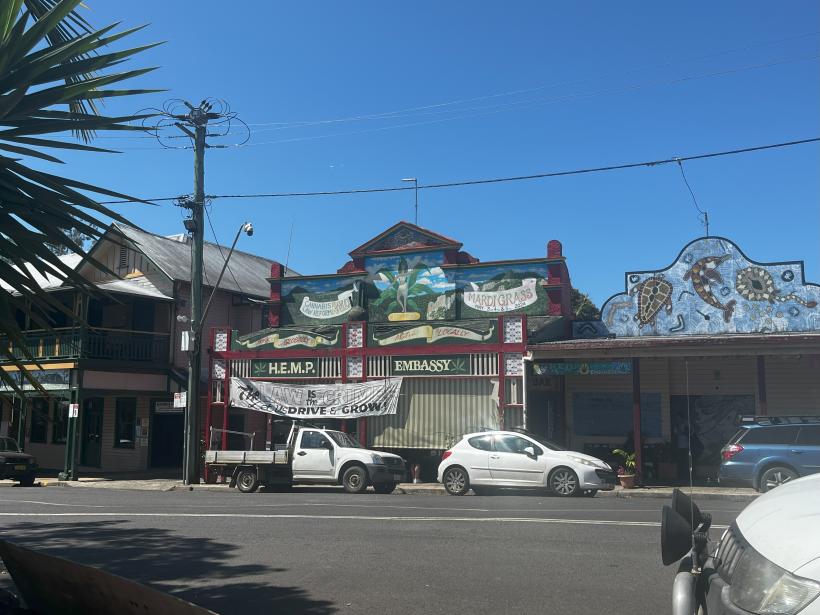

Nimbin sits in a small valley in the Northern Rivers region of New South Wales, ringed by the volcanic remnants of Mount Warning. Today the town is known around the world for its alternative culture, but that reputation is only about fifty years old. For much longer before that, Nimbin was a quiet dairying town, and long before European settlement, it was Bundjalung country.
Who Lived in the Nimbin Valley Before European Settlement?
The Nimbin valley and the surrounding Northern Rivers region are the traditional country of the Bundjalung people. The Bundjalung nation is made up of many clan groups spread across northern New South Wales and into southern Queensland, and their connection to this landscape goes back tens of thousands of years. The word "Nimbin" itself is generally understood to come from a local Aboriginal language, though its exact original meaning has been recorded differently by different sources over the years.
Bundjalung culture is tied closely to specific landmarks in this region, including the rocky outcrops, rivers, and mountains around Nimbin. Rainbow Snake stories, in particular, describe how the ancestral being shaped rivers, waterholes, and hills as it moved through the country. For readers who want the fuller version of that story, and how it connects to real places near Nimbin and Lismore, our article on the Rainbow Snake in Bundjalung mythology covers it in detail.
Colonisation in the nineteenth century brought major disruption to Bundjalung communities across the region, including displacement from traditional land as timber-getters and then farmers moved in. That history is part of the town's story too, even though it is not always the part visitors hear about first.
What Was Nimbin Like During the Dairy Farming Era?
From the late nineteenth century through most of the twentieth century, Nimbin developed as a small agricultural service town, and dairy farming became the backbone of the local economy. Cedar-getters had cleared much of the surrounding rainforest in earlier decades, and the fertile volcanic soil left behind was well suited to pasture. Small dairy farms spread across the hills around the valley, and Nimbin grew as the town where farmers came for supplies, banking, and a local butter factory to process their milk.
By the middle of the twentieth century, Nimbin had the shape of a typical rural New South Wales township: a main street, a few shops, a school, churches, and a population built around farming families. It was unremarkable in the way many small dairy towns across the region were unremarkable, and there was little sign of what was coming next.
Like many dairy districts in Australia, Nimbin's farming economy began to decline in the decades after the Second World War as the industry consolidated and larger, more efficient operations elsewhere took over much of the market. Smaller farms struggled, the local butter factory eventually closed, and by the early 1970s Nimbin was a town in economic decline, with empty shopfronts and a shrinking population.
How Did the 1973 Aquarius Festival Change Nimbin?
The turning point in Nimbin's history is well documented and widely agreed on: the Aquarius Festival, held in the town in May 1973. The festival was organised by the Australian Union of Students, who had previously held Aquarius festivals at university campuses and were looking for a rural location for a larger, longer event centred on alternative culture, environmentalism, and communal living.
Nimbin's declining population and cheap, available land made it a practical choice, and the town's residents agreed to host the event. For around ten days, thousands of young people from across Australia and overseas arrived in the valley for a festival built around music, art, alternative lifestyles, and ideas about living close to the land. It was very different from the small farming-town life Nimbin had known for decades.
What made Aquarius different from a typical music festival was that many participants stayed on afterwards, or returned soon after. Cheap former dairy land in the surrounding hills was bought up and turned into share farms, communes, and multiple-occupancy communities, several of which are still there today. This is generally regarded as the beginning of the "back-to-the-land" movement in the region, and it reshaped Nimbin's population, economy, and identity within a few years.
What Is Nimbin Known for Today?
In the decades since Aquarius, Nimbin has become known as one of Australia's most recognisable centres of alternative and counterculture living. The town's main street is lined with colourfully painted shopfronts, and it has a strong association with cannabis culture, environmental activism, and community events that grew out of the movement the festival started. The annual Mardi Grass festival, focused on cannabis law reform, is one of the more well-known events to come out of this identity.
The surrounding hills still hold many of the intentional communities and multiple-occupancy properties established in the years after 1973, and the region is also known more broadly for organic farming, arts and crafts, and a general reputation for doing things differently from mainstream rural Australia. Tourism has become an important part of the local economy, with visitors drawn by the town's reputation as much as by the surrounding rainforest and mountain scenery.
Nimbin's story, from Bundjalung country, to a struggling dairy town, to Australia's best-known counterculture hub, is unusual among small Australian towns. You can read more about the town, its culture, and its history on our Nimbin homepage.
Nimbin Timeline: Key Periods in Its History
| Period | What Happened |
|---|---|
| Pre-colonial era (tens of thousands of years before European settlement) | The Nimbin valley is Bundjalung country, with a deep cultural connection to the local landscape, including Rainbow Snake stories tied to the region's rivers and hills. |
| Mid-to-late 1800s | Cedar-getters and early settlers clear much of the surrounding rainforest; Bundjalung communities are displaced as farming land is taken up. |
| Roughly 1900s-1960s | Nimbin develops as a dairy farming service town, with a local butter factory and an economy built around small family dairy farms in the surrounding hills. |
| Roughly 1950s-early 1970s | The dairy industry declines as farming consolidates elsewhere; Nimbin's population shrinks and the town struggles economically. |
| May 1973 | The Aquarius Festival, organised by the Australian Union of Students, is held in Nimbin, drawing thousands of visitors and sparking the back-to-the-land movement in the region. |
| Mid-1970s to today | Former dairy land is converted into communes and multiple-occupancy communities; Nimbin develops its ongoing identity as a centre of alternative culture, activism, and tourism. |
FAQ:
What did Nimbin look like before the 1970s?
Before the 1970s, Nimbin was a small dairy farming town like many others in the Northern Rivers region, with a local butter factory and an economy centred on small family farms. By the early 1970s, the dairy industry had declined and the town was struggling, with a shrinking population and empty shops.
What was the Aquarius Festival?
The Aquarius Festival was held in Nimbin in May 1973, organised by the Australian Union of Students. It brought thousands of young people to the town around themes of alternative living and environmentalism, and many stayed on afterwards, which is generally seen as the start of Nimbin's counterculture identity.
Who lived in the Nimbin area before European settlement?
The Nimbin valley is part of the traditional country of the Bundjalung people, whose connection to the region includes cultural stories tied to local landmarks, such as the Rainbow Snake creation stories associated with nearby rivers and hills.